Emerald Cut Diamond Bracelets for Women
Most diamonds on a bracelet are curves. The emerald cut is a rectangle, with straight sides, clipped corners and long flat facets that flash instead of sparkling. On the wrist it behaves more like architecture than ornament, lining up neatly with a watch face or a cuff. Our emerald cut bracelets use that geometry in single stones, sideways settings and full tennis lines.
Long Mirrors Instead of Sparkle
A round or oval diamond is a brilliant cut, with many small triangular facets that break light into a busy glitter. An emerald cut is a step cut: its facets are long and parallel, stepping down from the table like a set of stairs. Instead of scattered sparkle, it gives broad, clean flashes of light as the wrist turns, followed by calm dark planes. Jewelers call the look a "hall of mirrors".
Because a step cut shows the inside of the stone so openly, clarity matters more than with a brilliant. On a bracelet that concern softens. The stones are smaller and seen at a distance, so the overall flash counts for more than tiny details inside each one. The four corners of the rectangle are cut off at an angle, which protects them from chipping, an important detail on a wrist that knocks against tables and bags.
One Rectangle on a Chain
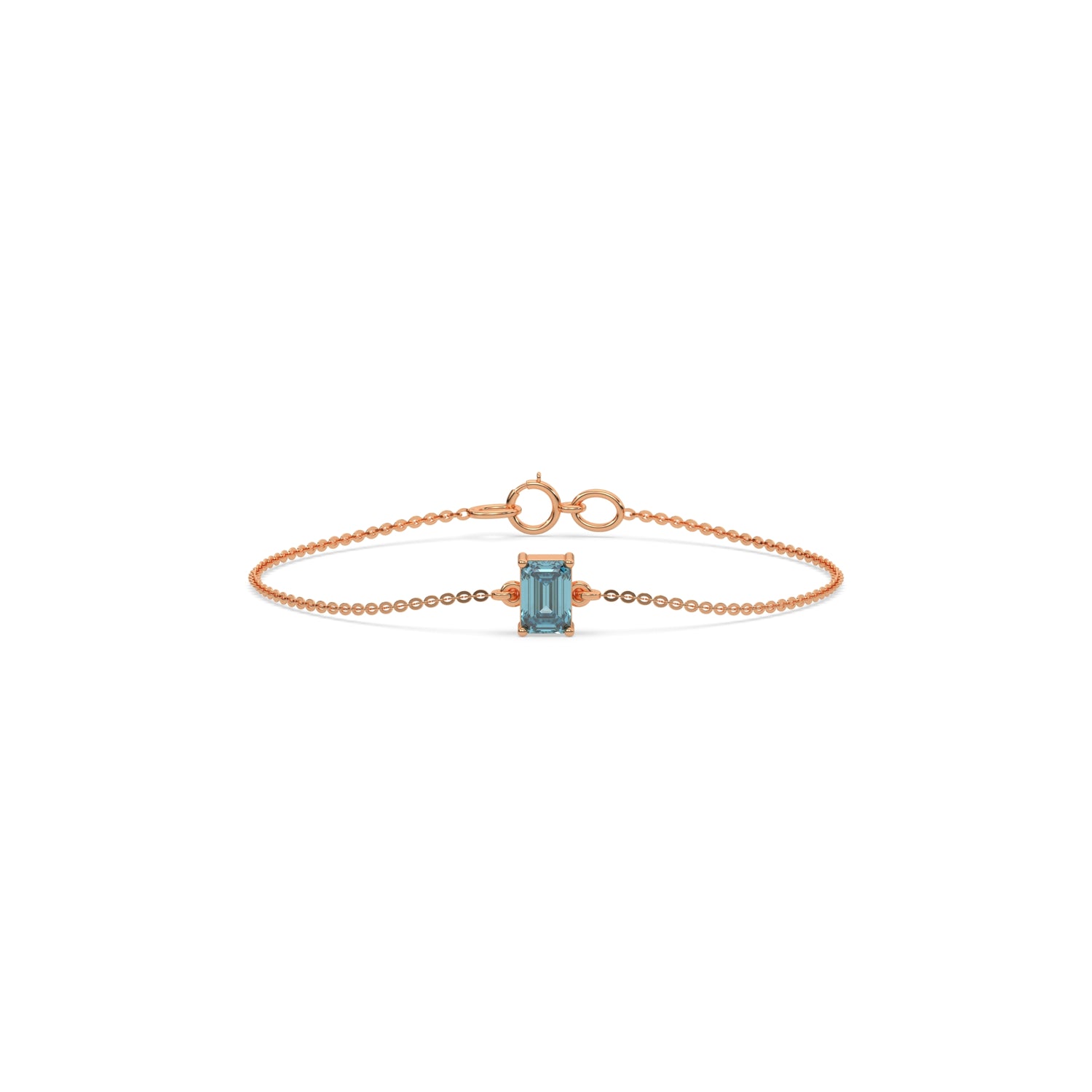
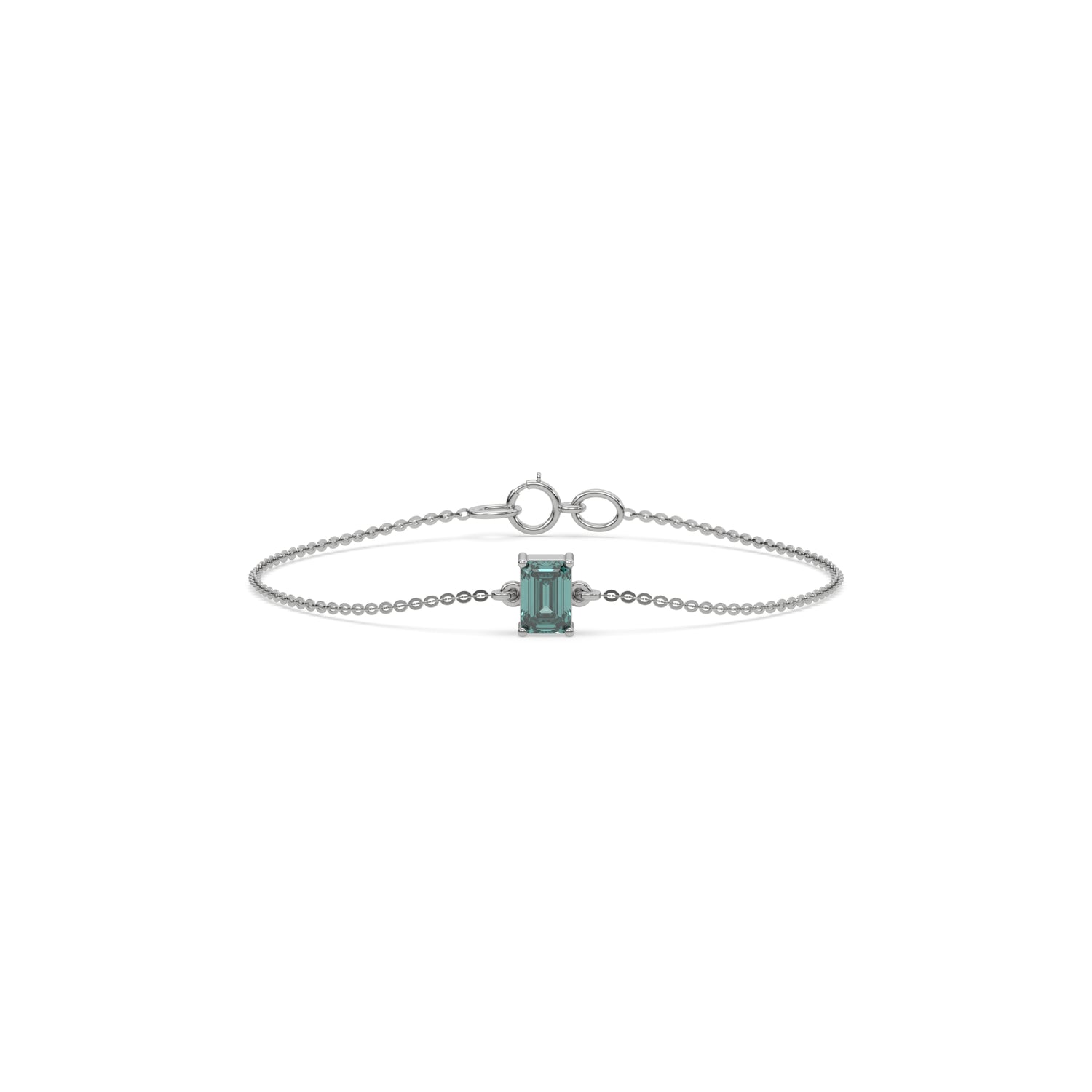
The simplest emerald cut bracelet holds one stone on a fine chain. We make it with white natural and lab-grown diamonds, in a bezel or in prongs. The bezel frames the rectangle in a thin line of gold, which sharpens its outline and makes it look slightly larger; the prong version leaves the sides open so the step facets flash more freely. Lengthwise along the wrist, the stone looks like a small mirror catching the light. All five solitaire shapes are gathered in our solitaire bracelets.
Turned Across the Wrist
The east-west bracelet sets emerald cuts sideways in bezels, so the long side of each rectangle runs across the wrist. The effect is crisp and graphic, close to a row of small tiles, and it echoes the face of a rectangular watch beautifully. It's made with lab-grown diamonds and is the most modern-looking piece in the collection.
A Line of Rectangles
Two tennis bracelets set an emerald cut in every link. In the prong-set line, the rectangles sit end to end and the bracelet flashes in a steady rhythm as it moves. In the bezel-set line, each stone is framed in gold, so the bracelet reads as a row of outlined rectangles, quieter and smoother against the skin. Both are lab-grown, and they sit with our other lines in our lab-grown tennis bracelets.
One Emerald Cut Among Rounds
The 1.35 carat round tennis bracelet breaks its own pattern once: a single emerald cut diamond sits at the center of a line of round brilliants. The rounds supply sparkle all the way around, and the rectangle adds a focal point on top of the wrist, a moment of flash among the glitter. It's offered in natural and lab-grown diamonds, and it suits anyone who loves the emerald cut but wants a familiar round line around it.
Emerald cuts also appear among the mixed shapes in our multi-shape designs: the by-the-yard and station bracelets, the east-west multi-shape line and the 2.50 carat multi-shape bracelet. For more step cuts, our baguette bracelets take the same geometry to slimmer stones.
Step-Cut Color
Eight emerald cut solitaires carry a colored diamond: pink, yellow, blue or green, in a bezel or in prongs. Each is lab-grown and colored by treatment after growth, which we disclose on every listing. The broad table of an emerald cut shows color evenly and clearly, so these stones read almost like colored glass panes on the wrist. All four colors are in our colored diamond bracelets.
Our lab-grown stones are CVD grown. Natural diamonds from half a carat come with an IGI or GIA report, lab-grown diamonds from 1 carat with an IGI report, and any bracelet over $800 also ships with a GSI jewelry certificate. Each piece is made to your wrist size in 10K, 14K or 18K gold, in yellow, white or rose, and many designs also come in 925 sterling silver, though not all of them.
Emerald Cuts for the Bride
The emerald cut has a strong bridal history. It was a favorite of the Art Deco era of the 1920s and 1930s, when jewelry turned geometric, and it still suits brides who want something clean, tailored and slightly old Hollywood rather than romantic and frilly.
For a bride with an emerald cut engagement ring, a prong-set emerald cut tennis line repeats the same rectangle on the wrist, so ring and bracelet look designed together. If her ring is a round or oval, the 1.35 carat line with an emerald cut center bridges the two: rounds to match the ring, one rectangle to bring in the step cut. A bride who prefers a single piece can wear a white emerald cut solitaire on a fine chain, which keeps the wrist simple and lets the ring lead.
The gown matters too. Structured fabrics like crepe, mikado and satin suit the emerald cut's straight lines, and a column or slip dress looks especially sharp with the east-west bracelet. With lace sleeves, choose a bezel design that won't snag. A blue emerald cut solitaire is an elegant "something blue", while bridesmaids in a color palette can each wear a colored emerald cut to match. For the mothers, a bezel-set white solitaire is polished and understated.
Our guide to picking a bridal bracelet goes through timing and fit, and our emerald cut engagement rings and emerald cut wedding bands complete the set.
If you want a design we don't list, such as larger emerald cuts, a natural emerald cut tennis line, or a bracelet that alternates emerald cuts with baguettes, our custom design team can quote it. We ship free within the US and take international orders too.