Princess Cut Diamond Necklaces for Women
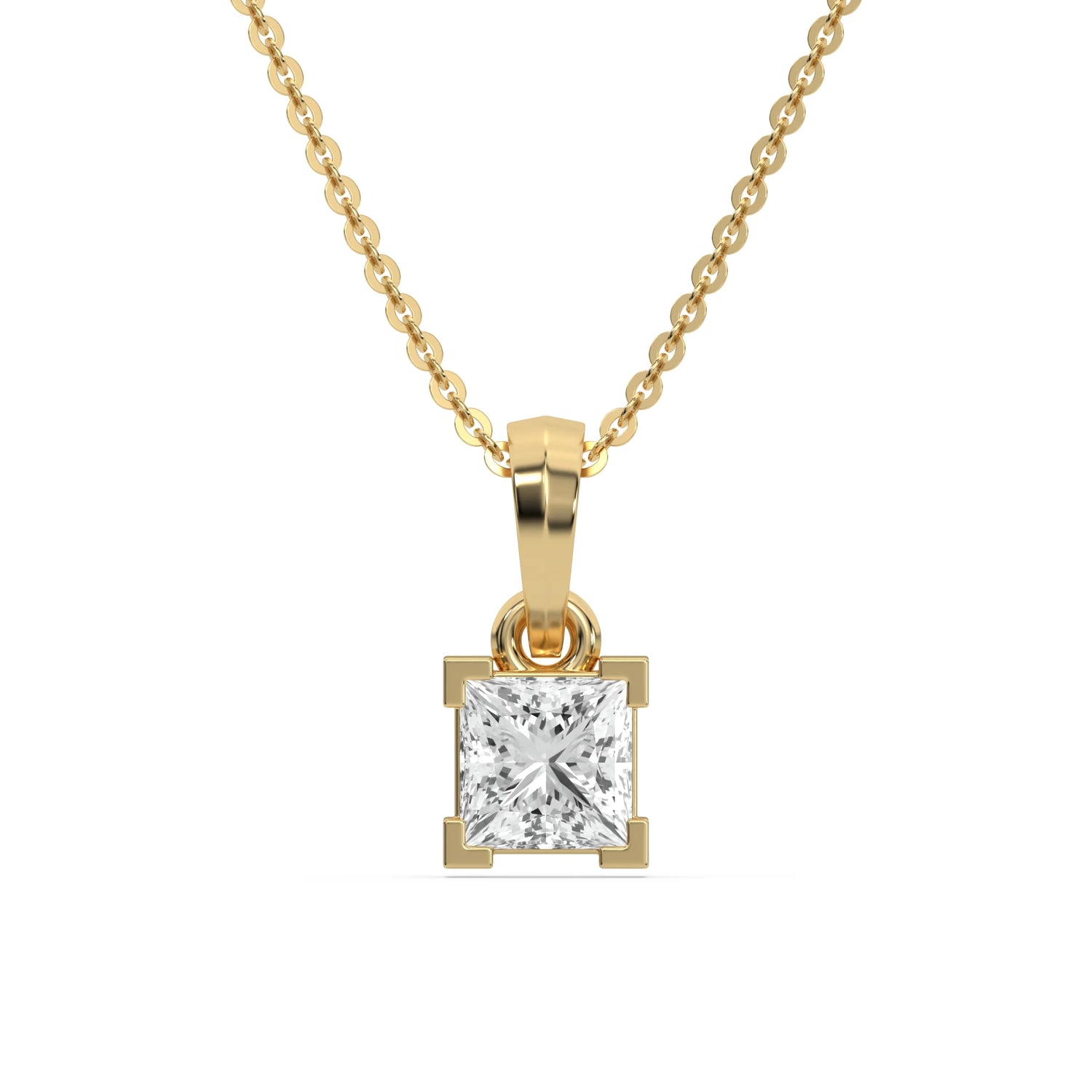
Chances are the diamond necklaces you already own are built on curves: a round solitaire, a teardrop, a soft cluster. A princess cut changes that with four straight sides and four sharp corners, yet it still throws the bright, scattered sparkle of a brilliant cut. Our princess necklaces use that square in two ways, sitting.
Straight Edges Among the Curves
The princess cut was developed in the late 1970s and early 1980s as a square answer to the round brilliant. Its facets run in chevrons from the center out to the corners, so the stone sparkles like a round even though its outline is a crisp geometric square. Because the shape follows the natural form of a rough diamond crystal more closely than a round does, more of the original stone survives the cutting.
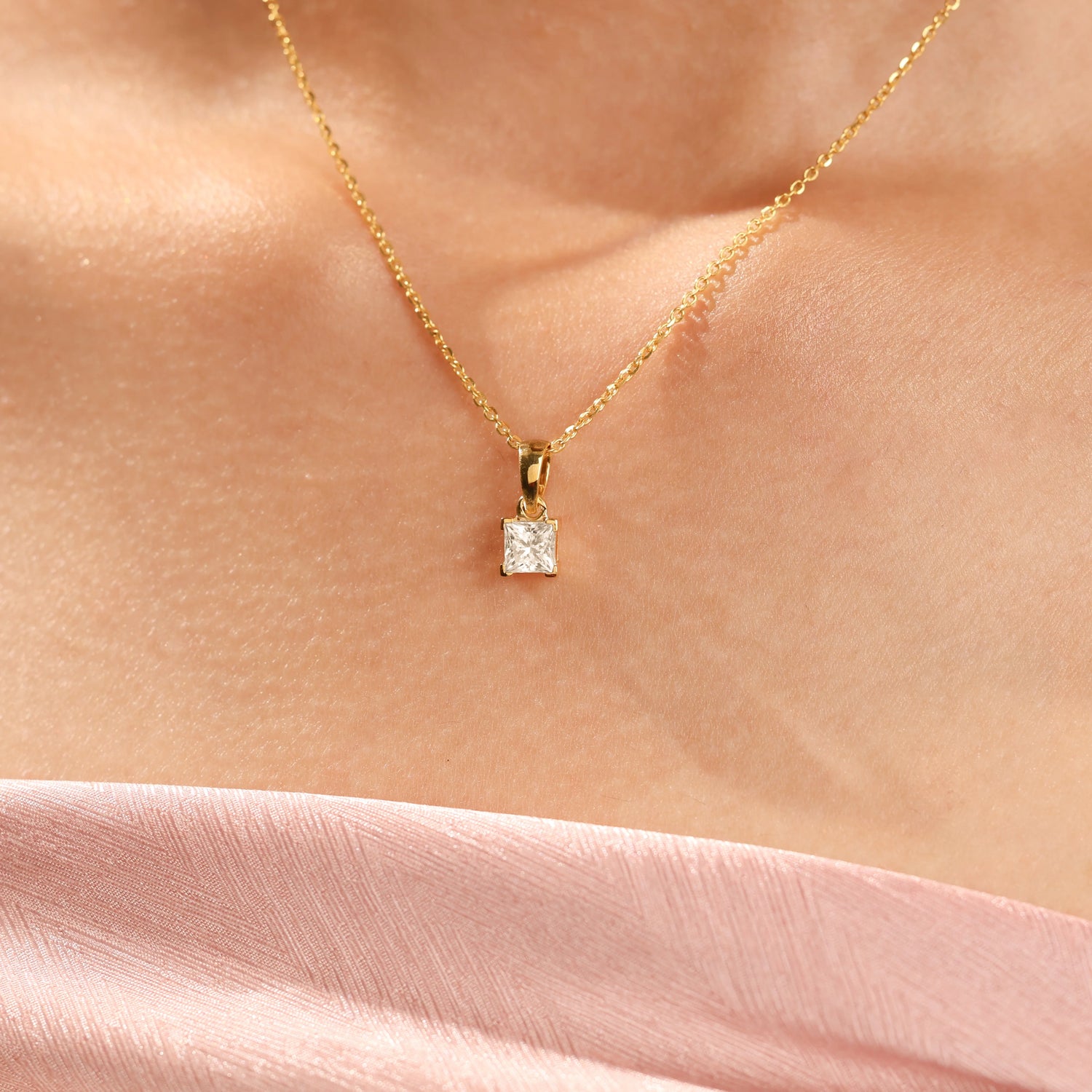
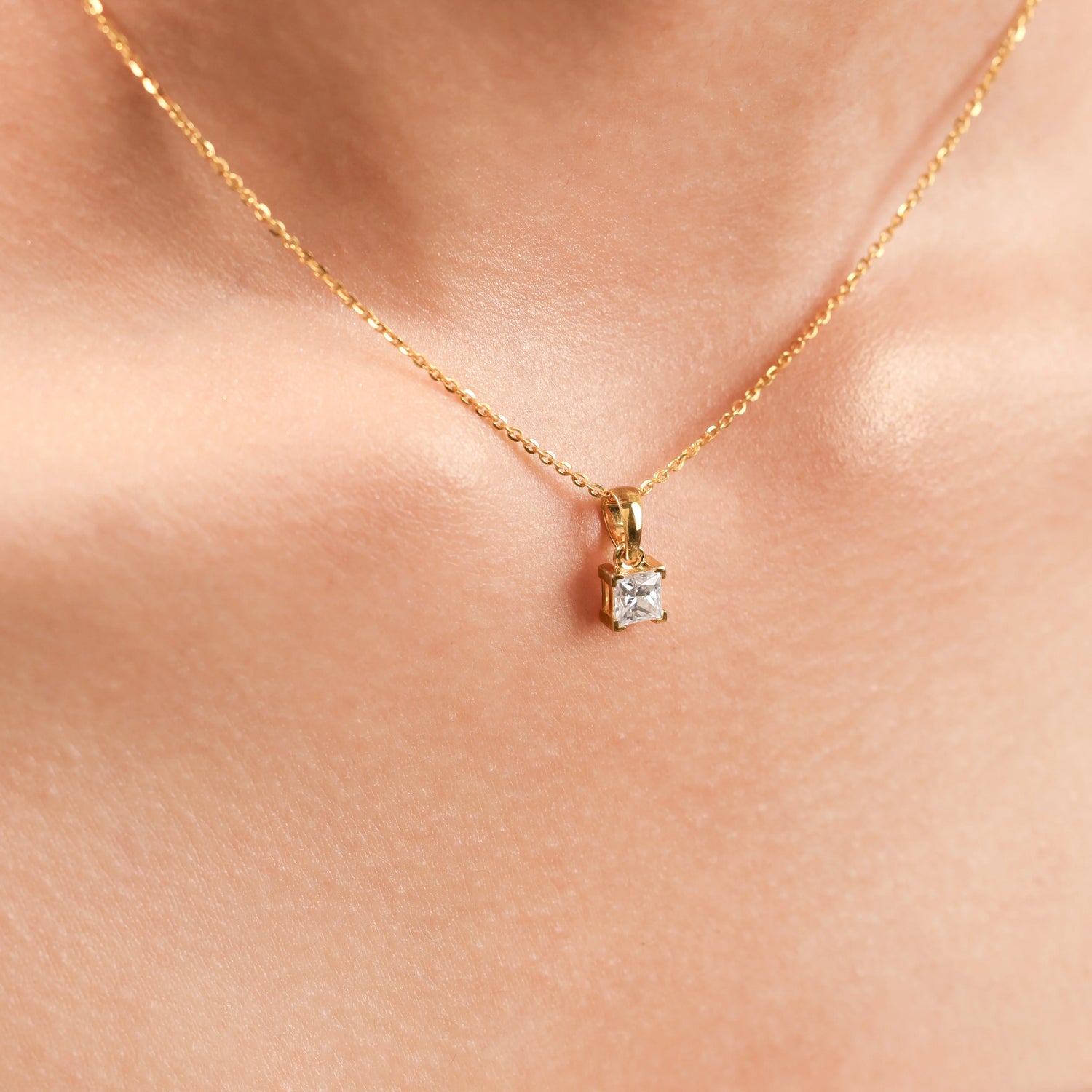
At the neck, that outline matters more than you might expect. A round pendant reads as a point of light; a princess reads as a shape. You notice the corners, the straight top edge and the way the square lines up with the chain. It suits open necklines, crisp collars and anyone who prefers jewelry with a slightly architectural feel. A single princess on a fine chain moves easily from a blazer at a morning meeting to a plain tee on the weekend to a dress at dinner, because the square looks tidy against every one of them. If you're still deciding between the two outlines, our princess versus round guide was written for rings, but the comparison of sparkle and shape applies just as well to a pendant.
The Compass Setting: Corners at North, South, East and West
The single biggest choice with a princess pendant is which way the square faces. Set straight, its sides run parallel to the chain and it looks calm and orderly, almost like a window. Turned 45 degrees, it becomes a diamond shape, with one corner pointing up toward the chain and one pointing down toward the heart.
That turned position is what we call compass set. The stone is held by four prongs placed at the points of a compass, one at each corner: north, south, east and west. Two of our necklaces use it: the 1 ct lab-grown compass-set halo and the 0.50 ct lab-grown compass-set cluster.
Turning the stone also changes its size on the body. A square measures more across its diagonal than along its sides, so a princess set on point looks wider and taller than the same stone set straight. On a 1 carat princess, that adds well over a millimeter in each direction. The downward point also draws the eye in a gentle V, which flatters a scoop or V neckline.
Claws or a Collar of Gold
Every princess has four corners, and the corners are the most exposed part of the stone. How a pendant protects them changes both its security and its look.
Prong settings hold each corner in a small V-shaped claw. They keep metal to a minimum, let light reach the pavilion from the sides, and show the full square outline. Most of our princess solitaires and the compass designs are set this way.
A bezel takes the opposite approach and wraps a thin wall of gold around all four sides. The corners are fully covered, the pendant lies smoothly against skin and fabric, and the outline gains a fine frame of yellow, white or rose gold. We make a 1 ct natural bezel pendant and a 3 ct lab-grown bezel necklace for anyone who wants the square with nothing to catch on a knit or a scarf.
One Carat Natural, Three Carats Lab-Grown
Our princess solitaires come in two diamond types, and each one sets its own size range. Natural princess pendants are made with stones of 1 carat, and larger natural stones can be sourced on request. Lab-grown princess pendants go up to 3 carats, again with bigger stones available when you ask. Every lab-grown diamond we use is grown by the CVD method and is chemically and optically a diamond, and each product name says plainly which type you're buying.
Grading paperwork depends on the stone. Natural diamonds of half a carat and above come with an IGI or GIA report, lab-grown diamonds of 1 carat and up come with an IGI report, and any piece priced over $800 also ships with a GSI jewelry certificate. You'll find the full spread of single-stone styles across our natural solitaire necklaces and lab-grown solitaire necklaces.
Chains work in two ways. A few princess designs have the chain built in and arrive ready to wear. On pendants, a chain in silver, 14K or 18K gold can be added at checkout, while pendants made in 10K gold are sold on their own.
Princess Cuts Sharing the Spotlight
Not every princess necklace is a single stone. Three of our designs gather princess diamonds with others, and each one uses the square differently.
The 1.00 ct lab-grown cluster groups several princess stones into one larger shape, so their straight edges meet and form a bigger geometric outline. The 0.50 ct compass-set cluster arranges small stones around the on-point layout described above, giving a star-like look from a modest total weight. The 0.50 ct pear-and-princess cluster pairs the two shapes, with soft teardrops set against the hard lines of the squares. For more multi-stone designs in other cuts, our lab-grown cluster necklaces bring them together.
The fourth design is the compass-set halo. Here a 1 ct lab-grown princess sits on point inside a frame of small diamonds that follows its square outline. The halo adds a ring of sparkle around the edges, and the center stone appears larger than its weight alone would suggest.
Echoing the Square Elsewhere
A princess pendant pairs easily with other square pieces, because the shape is so recognizable. A princess engagement ring and a princess pendant look connected across the hand and the collarbone even when the designs are different. Keep the metal color the same for the clearest link, or mix yellow and white gold if you like a less coordinated look.
Our princess cut engagement rings and princess wedding bands are the natural partners for a bridal pendant. For everyday wear, small princess cut studs and hoops repeat the square near the face without competing with the necklace. The full range of square-cut pieces, including princess cut bracelets, is in our princess cut diamond jewelry collection.
Larger Stones and Your Own Layout
If the size or arrangement you have in mind isn't listed, we can make it. Popular requests include a natural princess above 1 carat, a lab-grown princess above 3 carats, a straight-set halo instead of a compass one, or a bezel version of a design that is currently prong set. Princess cuts can also be paired with other shapes in a custom cluster.
Pieces are made in 925 sterling silver and in 10K, 14K or 18K yellow, white or rose gold, depending on the design. Share your stone, metal and setting with our custom design team and they'll quote a piece around it. Shipping is free within the US, and we ship internationally as well.