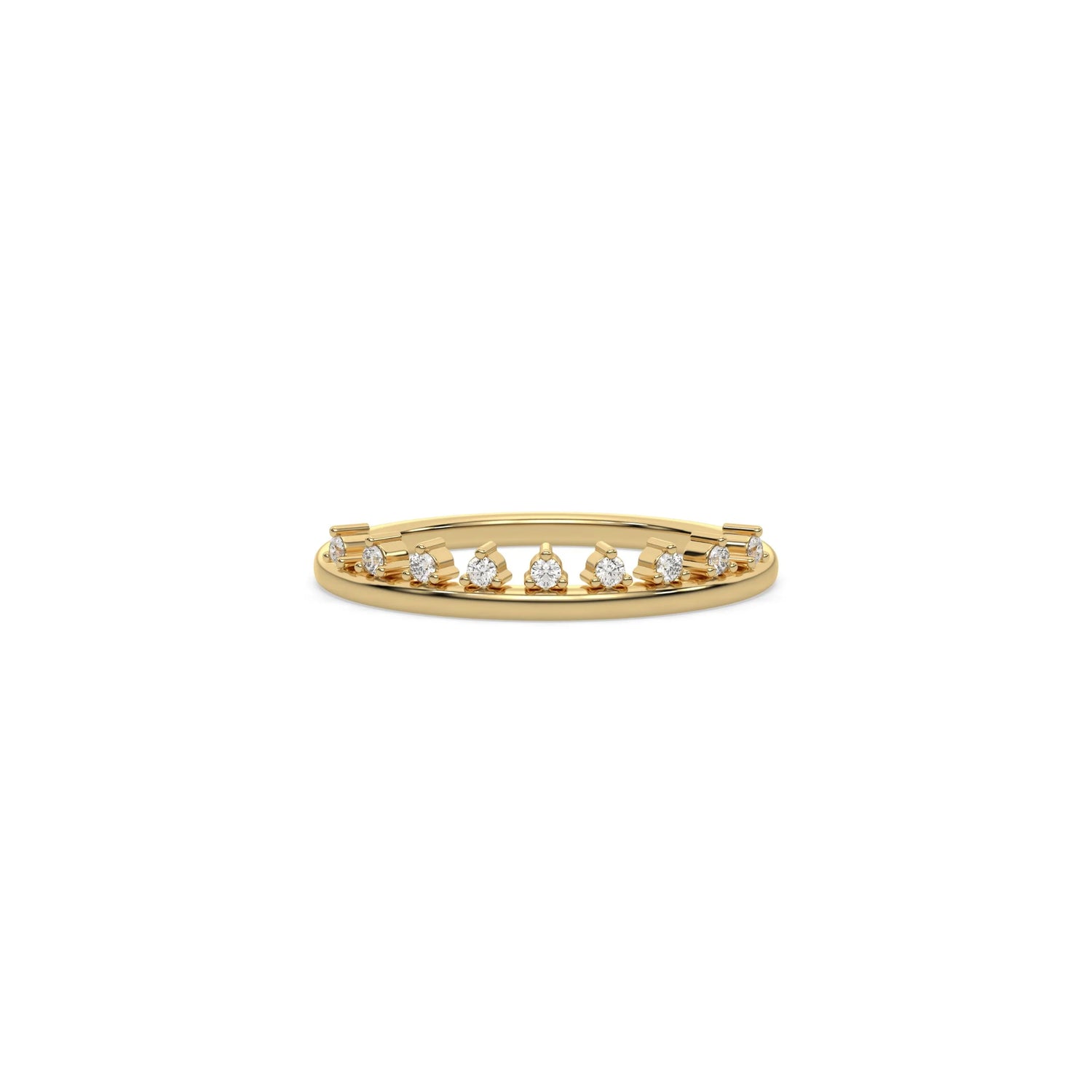
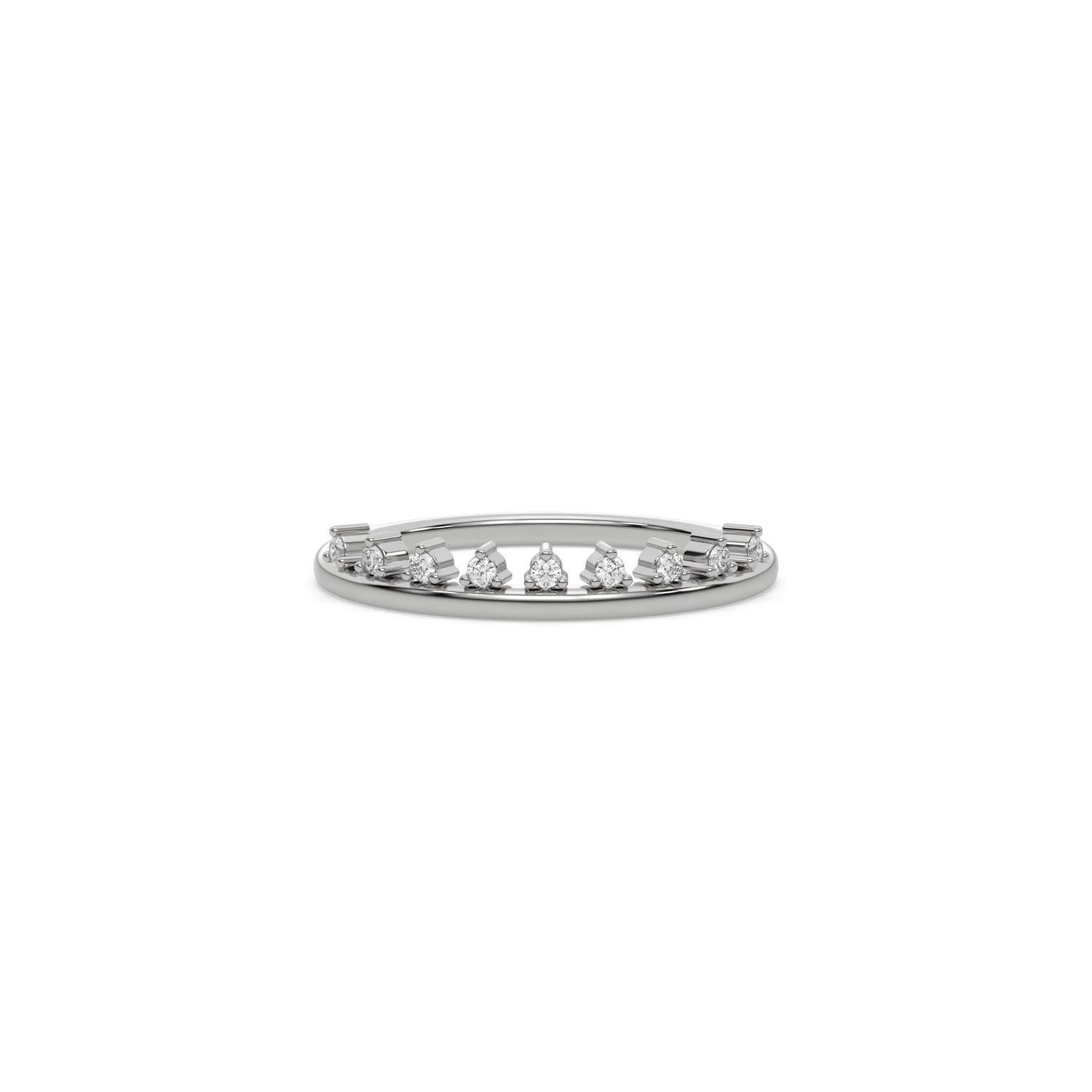
Curved Wedding Bands and Ring Enhancers for Women
A straight wedding band does not always sit flush against an engagement ring. When the center setting is wide or low, it pushes the band away and leaves a gap. A curved wedding band solves that by bending around the setting, and a ring enhancer goes a step further by framing the engagement ring on both sides. This collection covers both, with natural and lab-grown diamonds set in solid gold. For straight styles, see all of our women's wedding bands.
Curved Band, Chevron or Ring Enhancer?
These three terms get mixed up, and they describe different rings.
Curved band (also called a contour band). One band with a soft dip in the middle. The dip follows the outline of the center setting so the two rings sit close together. Our guide to curved wedding band styles shows the main variations.
Chevron or V band. One band that comes to a point instead of a rounded dip. The point can tuck under the tip of a pear or marquise stone, or sit as a V beneath a round one. See the chevron and V-shaped wedding bands guide.
Ring enhancer (also called a ring guard or wrap). A piece that sits on both sides of the engagement ring, usually as two connected bands with a space between them for the ring. It adds diamonds above and below at once. Browse our ring enhancers, and read the ring enhancers guide for how they are worn.
Do You Need a Curved Band?
Not every engagement ring does. A quick test tells you.
Slide a straight band, or any plain ring of similar width, next to your engagement ring. If the two touch along their length, a straight band will work and you can choose freely. If the setting holds the band away and you can see skin between them, a curved band will close that space.
Some women like the gap and keep a straight band anyway. That is a matter of taste. Our comparison of curved vs straight wedding bands shows both looks side by side.
Matching the Curve to Your Engagement Ring
How deep a curve you need depends on the setting more than on the diamond itself.
By setting style
- Solitaire. A high prong setting often clears a straight band. A low-set solitaire with a wide basket usually needs a gentle curve. See solitaire engagement rings.
- Halo. The ring of small diamonds widens the top of the ring, so a halo is the setting most likely to need a curved band, and often a deeper one. See halo engagement rings.
- Hidden halo. The extra diamonds sit under the center stone, so the fit depends on how wide that lower basket is. See hidden halo engagement rings.
- Side stone. The shoulders already carry diamonds. A slim curved band keeps the look from getting heavy. See side stone engagement rings.
- Bezel. A bezel sits low with straight sides, so a straight band often fits. A wide bezel may still need a slight curve. See bezel set engagement rings.
By center stone shape
- Round and oval. A rounded contour follows these outlines naturally.
- Pear and marquise. The pointed end suits a chevron band, which mirrors the tip.
- Emerald, princess and other straight-sided shapes. These usually pair best with a shallow curve or a straight band, since there is no rounded edge to follow.
The curve on each band is different, so compare the product photos with your own ring before ordering. If you are unsure, send us a photo of your engagement ring through our contact page.
Diamonds, Gold and Width
Diamond or plain. A curved band can be plain gold or set with diamonds along the top. Diamonds add a second line of light under the center stone. A plain band keeps the attention on the engagement ring.
Natural or lab-grown. You can choose either. Lab-grown stones are chemically the same as mined ones and generally cost less, which matters on a band with many small diamonds. Compare our natural diamond wedding bands and lab-grown diamond wedding bands, or read the lab vs natural diamond guide.
Gold color and karat. Match your engagement ring on both. Two rings worn side by side rub against each other every day, and matching metals tend to wear at the same rate. The 14K vs 18K gold guide explains the difference.
Width. A band that is much wider than the engagement ring's own band can look top-heavy. A similar or slightly slimmer width usually looks balanced.
Wearing a Curved Band Alone or in a Stack
A curved band has a visible dip when it is worn without the engagement ring. Some women like that shape as a ring of its own, and others find it looks unfinished. If you often take your engagement ring off for work or travel, think about which you would prefer to see.
Curved bands also stack. Two matching curves, one above and one below the engagement ring, give a similar effect to a ring enhancer while staying as separate rings. Our guide on how to stack a wedding band with an engagement ring covers the order and spacing. For bands with diamonds all the way around, see eternity bands and half eternity rings.
How to Choose
- Do the gap test. Find out whether you need a curve at all.
- Pick the type. A curved band for a rounded setting, a chevron for a pointed stone, or an enhancer to frame the ring on both sides.
- Judge the depth. Compare the curve in the product photos with the width of your setting.
- Match the metal. Use the same gold color and karat as your engagement ring.
- Confirm the size. Order the same size as your engagement ring unless you plan to wear the band on another finger. See our size guide and returns and exchange policy.
Our guide on how to choose a wedding band for an engagement ring goes through the same steps in more depth. For cleaning between two rings worn together, see the care guide. If no existing curve fits your ring, you can ask about a custom design.
Find Your Curved Band at Diagaa
Start with the gap test, then browse every curved wedding band in the collection. If you would rather frame your engagement ring on both sides, go to the ring enhancers linked above.