Marquise Engagement Rings for Women
A marquise engagement ring is rarely chosen alone. Its two long points reach toward whatever band sits beside it, so the shape shapes the whole bridal set. Our marquise rings come in solitaire, halo, bezel, bezel pavé and hidden halo designs, with natural, lab-grown or colored centers, and this page explains how each one meets a wedding band.
Why the Points Meet the Band
Most engagement stones are round or close to it at the edges, so a straight band can slide right up against them. A marquise is different. Set lengthwise along the finger, its two tips extend toward the edges of the ring, and in many settings they overhang the band slightly. Push a straight band up beside it and the tip touches first, leaving a small gap along the rest of the ring.
Some brides like that gap; it gives each ring its own space and keeps metal from rubbing against the stone. Others want the two rings to sit as one, which is where curved and contoured bands come in. Either way, planning the band alongside the engagement ring saves a surprise later. The stone itself, including proportions and protecting its tips, is covered on our marquise cut diamond rings page.
How Each Setting Sits Beside a Band
The solitaire holds the marquise in prongs, with a V-shaped prong at each tip. It sits fairly high, so a straight band may slide partly beneath the stone; a slim curved band closes the gap neatly.
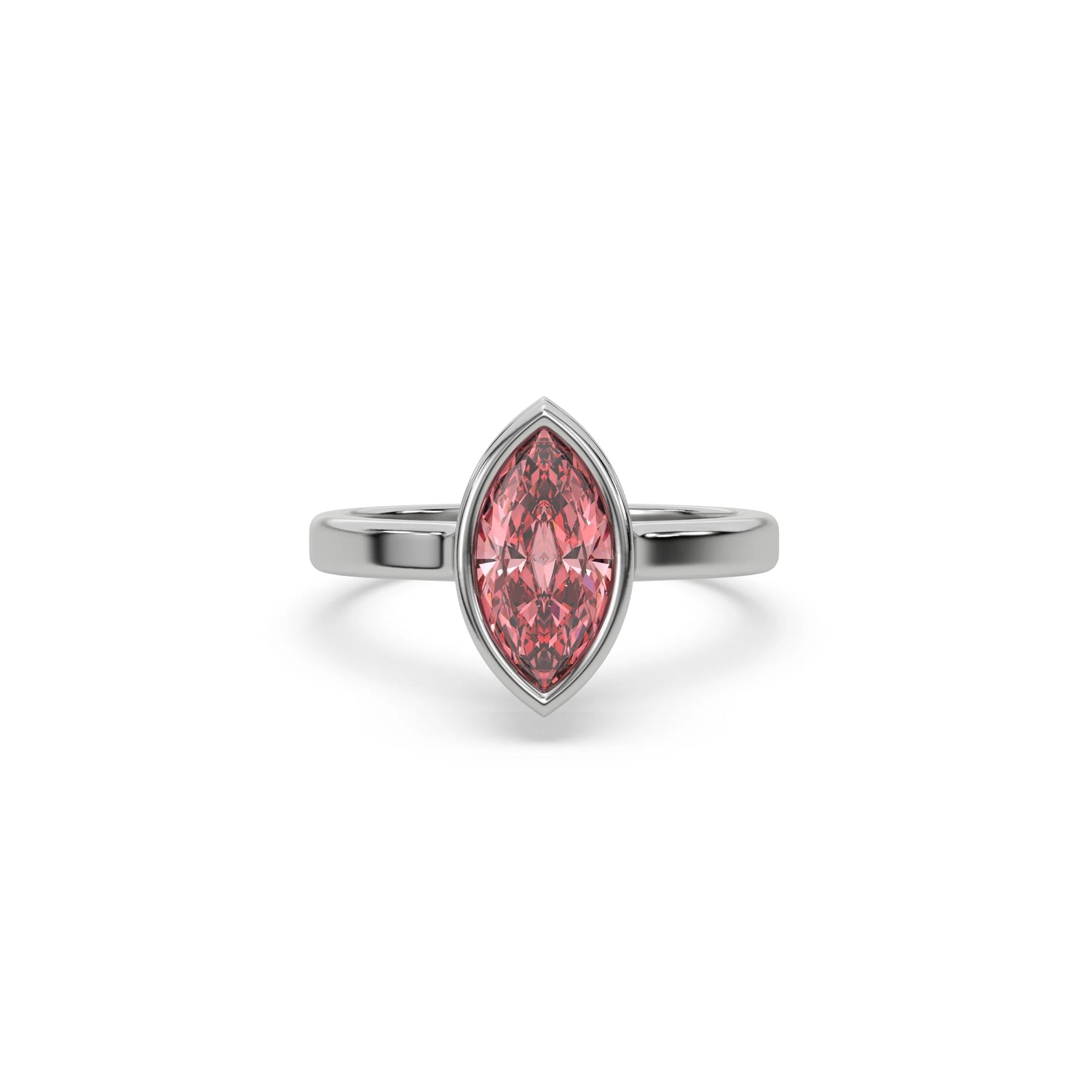
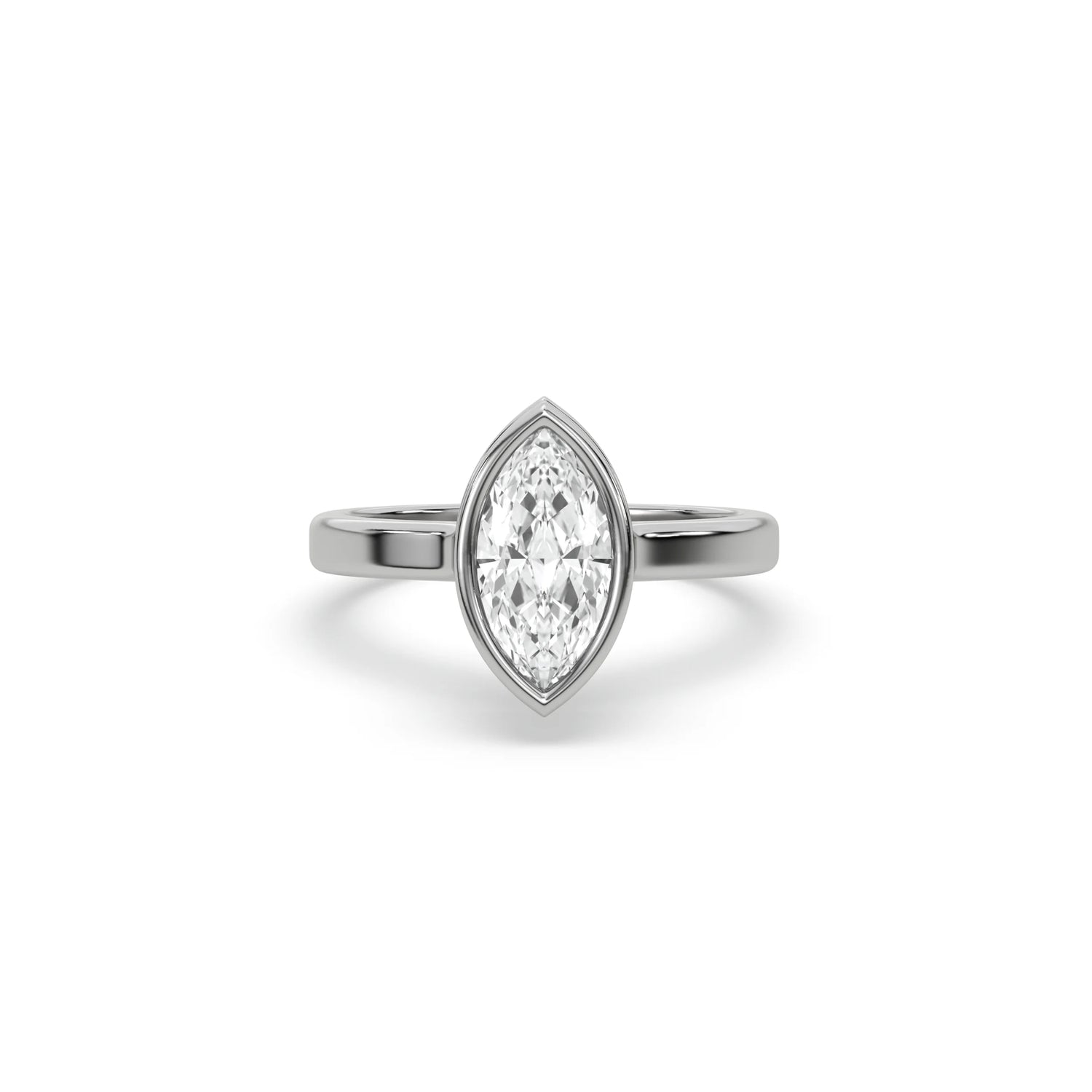
The bezel wraps the whole outline in a smooth rim of gold and usually sits lower on the finger. Because the rim covers the tips, the band meets metal rather than diamond, and a gently contoured band follows the bezel's curve cleanly. The bezel with a pavé band keeps that low, protected center and adds small diamonds along the shank, which a matching pavé band continues.
The hidden halo places small diamonds beneath the marquise, visible from the side. The added gallery lifts the center slightly, so a straight band usually sits flush below the stone, with the tips just above it.
The halo traces the marquise in small diamonds, widening the center and lengthening the tips. It's the setting most likely to need a curved or notched band, because the halo extends furthest over the edge of the ring. Compare these setting styles across shapes in our halo engagement rings and bezel-set engagement rings.
Bands That Curve Around a Marquise
There are three common answers to the gap. A curved band dips gently in the middle to follow the stone's outline. A chevron or V-shaped band points toward the center, mirroring the marquise's tips and creating a deliberate, interlocking look. A notched band has a small cut-out where the tip sits.
A ring enhancer goes a step further: it's a band, or a pair of bands, designed to wrap around the engagement ring from one or both sides, often adding diamonds that frame the center. It turns a simple marquise solitaire into a fuller set. Our curved wedding bands and ring enhancers include pieces made to sit with our marquise rings, and our marquise wedding bands repeat the shape in the band itself. When choosing, bring the engagement ring or its exact details, since the curve of the band needs to match the length and height of your marquise. A band that's slightly too curved can tilt the ring; one that's too straight leaves the gap you were trying to close. Matching the metal color ties the two rings together so they read as one piece on the hand.
Natural, Lab-Grown or Colored Centers
Every marquise design comes with one of three centers.
A natural marquise is mined and offered at 1 carat, with larger natural stones sourced on request. From half a carat up, each natural center comes with an IGI or GIA grading report. Browse mined designs in our natural diamond engagement rings.
A lab-grown marquise is grown by the CVD method and is a true diamond in composition and hardness. Listed lab-grown marquises go to 3 carats, with bigger stones available on request, and IGI grades every lab-grown center of a carat or more. Our lab-grown diamond engagement rings show the larger sizes.
A colored marquise brings pink, yellow, blue or green to the center, in five designs: solitaire, solitaire bezel, bezel, halo and hidden halo. These are lab-grown diamonds colored by treatment after growth, which every listing discloses, even where an older product name leaves out "lab". Colored marquises run to 3 carats listed, with larger to order. The long body of a marquise carries color from tip to tip, and the points gather a slightly richer shade. See all four in our colored lab diamond engagement rings.
Marquise rings above $800 also come with a GSI jewelry certificate. Each design is offered in 925 sterling silver and in 10K, 14K or 18K yellow, white or rose gold, so the band and engagement ring can be matched exactly.
Marquises Made to Your Design
Beyond the listed rings, we can make a marquise engagement ring to your idea: an east-west marquise set sideways across the finger, a three-stone ring with a marquise at the center, a toi et moi pairing a marquise with a second stone, or a white-diamond marquise with a pavé band or a halo with a pavé band. We can also source a natural marquise above 1 carat or a lab-grown one above 3, and design a matching band at the same time. Share your idea with our custom design team. US orders ship free, and we deliver worldwide.